

Gallery exhibition, Space 105
September 11— October 24, 2026
Opening Reception
September 11, 5:00-10:00 p.m. for Rentrée de Gaspé event
Public activity, Space 105
September 26, 2:00-4:00 p.m for Journées de la Culture events.
Details here
«[…] parce que tout se plie, se déplie, se replie.» — Gilles Deleuze¹
In the exhibition Résister le pli, artist Amélie Brisson-Darveau turns her attention to a technique as discreet as it is refined: textile pleating. The manufacturing process consists of meticulously arranging fabric in a mould or press, then subjecting the material to heat in order to permanently set the folds. Drawing on an investigation conducted with the last pleater still active in Montreal, Brisson-Darveau (re)considers the gestures, tools, and material conditions that give fabric an almost immutable form. Her project, however, does not seek to reconstruct a practice now largely abandoned by manufacturers. Rather, she transposes its processes into the realm of art, at the threshold of craft, where matrix, pressure, and impression become vehicles for reflecting on the transmission of a laborious and, moreover, meticulous form of know-how.
Brisson-Darveau conceived this project specifically for Atelier Circulaire. Located in the Édifice de Gaspé, a former building in Montreal’s second Garment District, the Atelier is situated in an area still marked by the memory of textile production. Industrial pleating, long practiced in Montreal, is now largely outsourced to Asia. Through interviews and observations made during her encounters with the pleater, Brisson-Darveau reconnects the threads of manual expertise while examining the industry's transformations and the productivist and consumerist forces that now shape it. A techno-social memory is thus woven through the still-visible traces of this manufacturing history.
The installation on view is comparable to a theatre of objects. Three tables, reduced to one-third of their original scale, reproduce the proportions of the work surfaces once found in pleating workshops. Arranged upon these stages are tools and textile fragments from the factory, removed from their original function to reenact, in sculptural form, the gestures of a savoir-faire increasingly destined to disappear.
Table 1. Weights used for pleating are reinterpreted in wood, molded, pressed, and printed. These objects become material allegories of an invisible force: pressure, both a constraint and a force of transformation. What once held material under tension becomes, in turn, a form to be experienced.
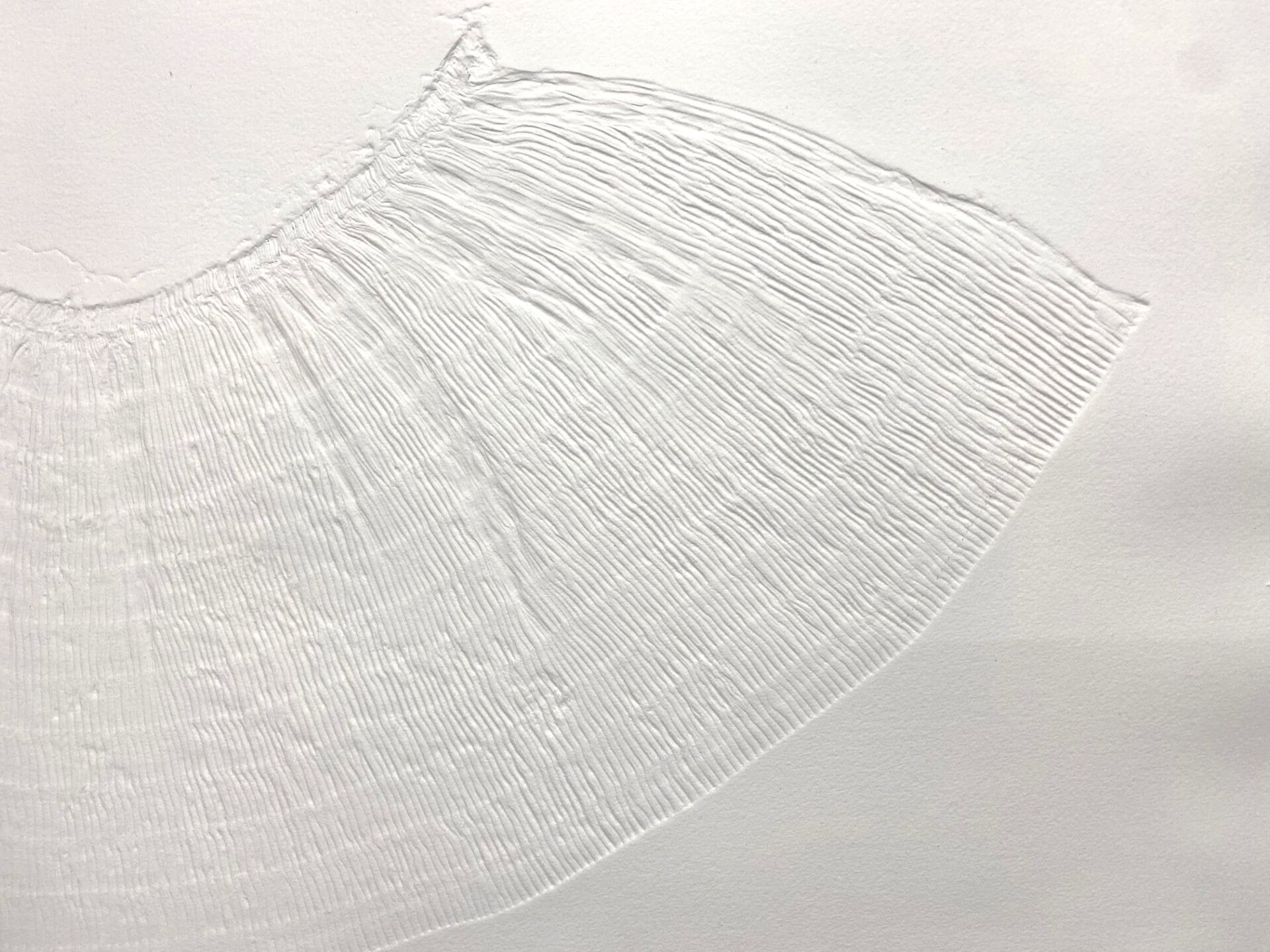
Table 2. Pleated second-hand garments serve as matrices for embossing: their folds and textures, inherited from mass production, leave their imprint on another material. The compositions the artist creates bring to the surface a tension between fast fashion and the slow temporality of the archive. What was designed to be consumed at great speed becomes the remnant of a process, the genesis of a labor.
Table 3. Ceramic half-cylinders reproduce the geometry of the press rollers. As elsewhere in the installation, Brisson-Darveau extracts an element from the mechanical apparatus and reworks it through the gestures of the hand and the manipulation of material. In this sense, she echoes the repetitive, physical rhythm of labor.
On the wall, set apart from the trio of tables, a reticular metal structure recalls the steam system. It holds a pinboard on which textile samples, pleating tests, fragments of fabric marked by manufacturing defects, documentary images laser-engraved onto wooden panels, and relief prints accumulate. Together, they form an indexical archive that seeks not so much to preserve a practice in decline as to reactivate its knowledge.
Amélie Brisson-Darveau is interested in what usually remains invisible: the reverse side of production and its subtleties, the repeated operations, the precision of each gesture, the control of heat, the calibration of pressure, the resistance of materials. By taking up these processes herself, the artist disrupts their original purpose. The relentless pace of industry gives way to the time of the studio; the instrument becomes sculpture; the discarded material, a matrix; the weight, an imprint.
How can the inevitability of disappearance be subverted? To resist, perhaps, by taking it back into one’s own hands. A promise of possible futures for pleating. Technical intimacy and tactile proximity.
— Jean-Michel Quirion
1. Gilles Deleuze, Le Pli : Leibniz et le Baroque (Paris : Les Éditions de Minuit, 1988)
Artistic statement and bio
Over the past several years, Amélie Brisson-Darveau has been developing immersive installations, often accompanied by drawings and performative movements. Through these works, she seeks to offer an alternative experience of the obscure and invisible elements of our environment (shadows in particular) by giving them volume and exploring their tangibility. She unfolds her work across multiple dimensions through experiments with the texture and structure of textiles, which she brings into relation with shadow and light. Through their movements within the space, visitors subtly establish connections between her research and her installations.
Through these projects exploring the materiality of shadow, she first became interested in German Romantic literature, film noir, and early horror films from the 1940s and 1950s, and more recently in public space. The project presented at Atelier Circulaire follows her residency at PHI Montréal (2022–2023), during which she explored questions related to urban space through clay impressions taken from the surfaces of deteriorating buildings. As pleating is inherently three-dimensional, shadow and light coexist within it. For this exhibition, she focuses on pleated textiles (pleating), both as a local material at risk of disappearing and as witnesses to Montréal’s ecological and urban transformations.
The research materials on which her project is based emerged from her investigations with Montréal’s last pleater, located near Chabanel Street in the city’s current Garment District. The business was previously located in Mile End, including in the building that now houses Atelier Circulaire. This is one of the reasons Amélie Brisson-Darveau wished to propose an exhibition at Atelier Circulaire.
Amélie Brisson-Darveau's artistic projects aim at offering an alternative experience of the “unseen” elements of social environments through an exploration of their tangibility and volume. She approaches her installation work through multiple dimensions by experimenting with the texture and structure of textiles that are put in relation with other materials such as ceramics, wood and light. Her work has been presented in numerous exhibitions and events in Canada, the United States and Europe, particularly in Switzerland, England, Germany, Finland, Lithuania, Norway, Turkey and France. She has received grants from the Canada Council for the Arts, the FQRSC and was a recipient of the Kaunas International Biennale’s Emerging Artist Award.
Acknowledgements
The artist would like to extend a warm thank you to Babu, manager and pleater at André Pleating Inc.; the entire team at Atelier Circulaire; the teams at L’Imprimerie and Atelier Clark; the PEC Fab Lab and Le Labo Fab Lab; as well as Alexis Lepage, Véronique Proulx, Claude Arseneault, Gregory Perrin, Guillaume Brisson-Darveau, Pavitra Wickramasinghe, Sophie Jodoin, Jean-Michel Quirion, Gisèle Trudel, Hugo Dalphond Laporte, Edith Sevigny Martel, and Éléonore Martin. This project was made possible thanks to financial support from the Fonds de recherche du Québec – Société et culture (FRQSC).
