Certain images stay with us for a long time. Trough repeated encounters, they eventually slip past our attention. Omnipresent, they become like visual reminiscences relegated to the margins of our gaze. They remain suspended until a detail, a line, or a form brings them back to life. During his childhood in Saint Petersburg, Russia, Montreal-based artist Alexey Lazarev regularly encountered one such lingering presence: Harvest (1931), a lacquer painting by Russian master miniaturist Ivan Markitchev. Reproduced on an even smaller scale, notably on a box of chocolates, this work belongs not only to art history but, above all, to Lazarev's everyday life.
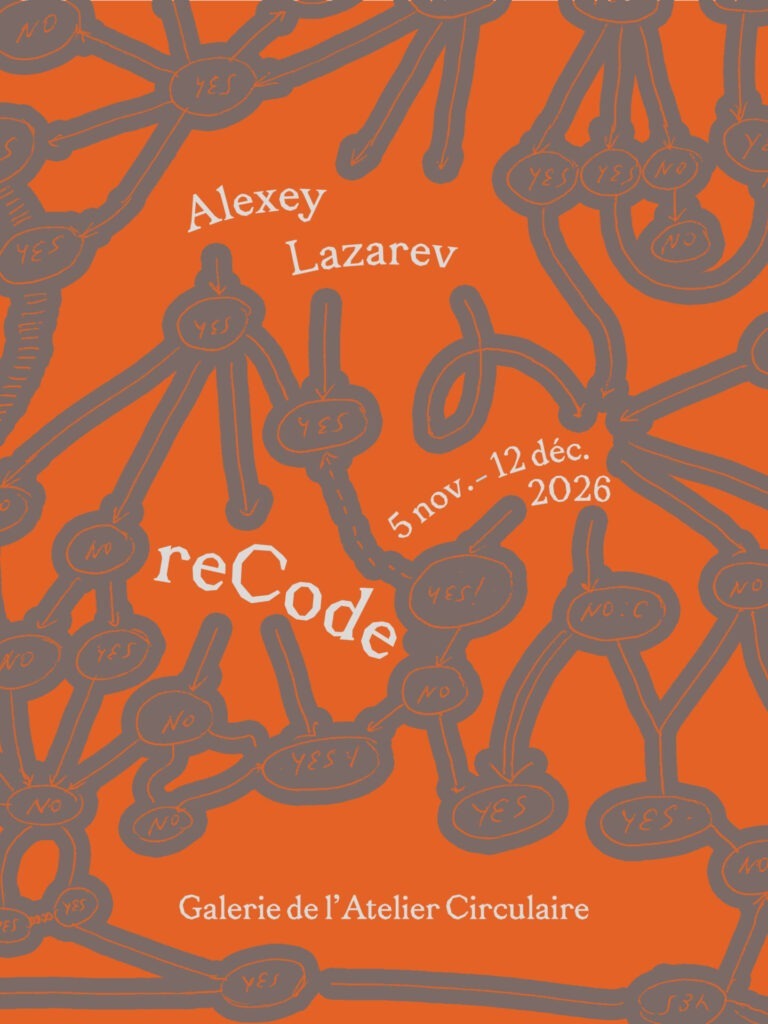
In the exhibition reCode, presented at Atelier Circulaire, Lazarev reactivates this memory, long held at the periphery of his gaze. He seeks, however, neither to reconstruct the work nor to reproduce its technique. Instead, he deconstructs, recomposes, and transposes it to explore what endures as context, function, scale, and material change.
This conceptual, formal, and material investigation draws on the history of Palekh, a Russian village where, after the October Revolution, a tradition of Orthodox icon painting was redirected toward secular lacquer miniature painting. Lazarev focuses on this transition from one visual regime to another. He examines it through the lens of adaptation as a means of cultural survival. While subjects and contexts change, certain ways of representing bodies and setting them in motion appear to persist.
This continuity manifests through in the gestures and relationships between the figures that Lazarev extracts from historical images and reduces to schematic forms. In Harvest, he isolates the lines of force and directional mouvements that structure the composition. Arrows, lines, and markers recode the work into a graphic vocabulary situated halfway between diagram and design. The eye no longer immediately grasps the scene: it moves through it, follows a path, encounters a point, and changes direction. Echoing the explorations of painter Kazimir Malevich, this reduction of figuration reveals the underlying architecture of the pictorial composition.
Yet this process does not end with drawing. The lines move from paper to plasma-cut metal. In this sense, the metal plates serve as printing matrices. Cut along the drawing's lines and then subjected to controlled oxidation, they gradually become covered in rust. The oxidation then transfers onto the fiber, with the rust acting as both a pigment and a printing process.
A vast installation composed of nine panels of Japanese Kitakata paper—a material whose fragility contrasts with the installation’s imposing scale—thus receives the impressions of these matrices. Bolted together, the panels are held slightly away from the wall by bent metal strips. The composition appears to maintain a precarious balance, as though it were barely resisting gravity.
Metal undergoes yet another transformation: folding. Within Atelier Circulaire itself, certain plates are folded like origami. An imposing relief extends across the floor, while a panel rests against a column; elsewhere, related forms punctuate the walls. Between horizontality and verticality, surface and volume, these shifts carry the principle of translation that runs throughout the exhibition into three-dimensional space.
reCode does not converge toward a central work. Analytical drawings, fragile papers marked by lines, metal plates cut through with fine strokes, touches of fluorescence (one of the artist's signatures), and erosive impressions constitute a field of interdependent investigations. The exhibition's progression connects these successive states. For Alexey Lazarev, recoding does not mean replacing one language with another, but rather observing what an image preserves, leaves behind, and (re)invents with each new transformation. What once persisted at the periphery of the gaze finds new ways of appearing, years later and thousands of kilometers from Saint Petersburg.
— Jean-Michel Qurion