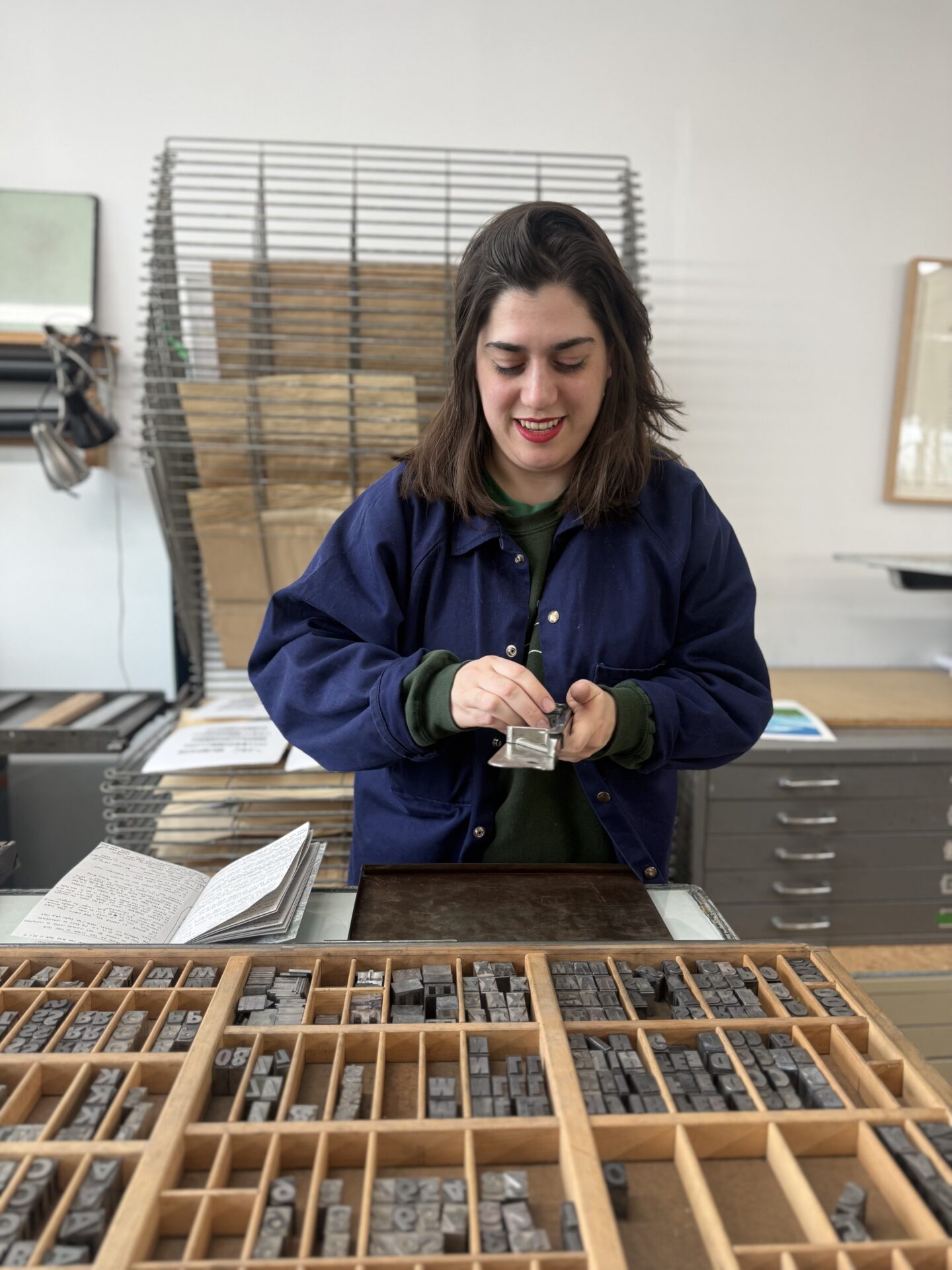
Camille-Zoé Valcourt-Synnott at the typography studio, February 2026
Country: Canada
Residency period: January 20– February 28, 2026
Public presentation: May 8 at 13h15 , space 517
Residency project: Camille-Zoé will develop and print a new series of text-based works that explore the working conditions of artists in Canada, using typography and risography techniques. As language and print are central to her practice, she began integrating typography last year during a tailored residency at L’imprimerie, centre d’artistes. She will continue working with typographic characters for this project, creating prints in a format suited for display (11” x 17”). Risography is another technique she wishes to further develop through training as part of her residency at Atelier Circulaire, in order to better equip herself for the production of a series of posters. The texts used will combine work-related expressions with reflections drawn from her experience in the cultural sector over the past few years.
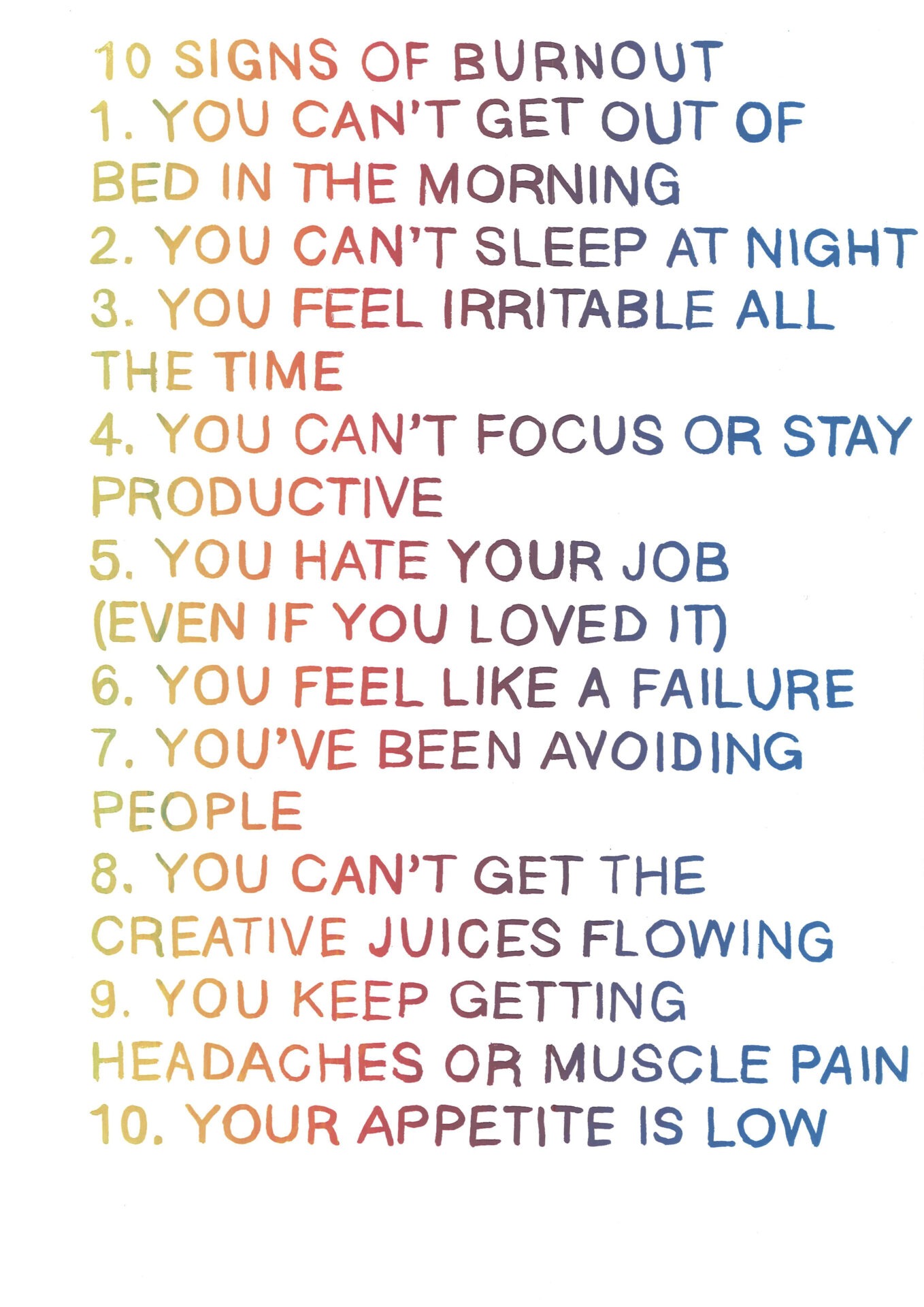
This project is a continuation of her poster series 10 Signs of Burnout, developed during an artist residency at Atelier d’estampe Imago in Moncton (NB) in February 2023. At that time, she screen-printed a series of ten posters listing the ten signs of burnout, based on a generic article found online. At the end of the residency, I installed the posters in the streets surrounding the centre, sharing the series outside the gallery space. This type of presentation interests me for its greater accessibility compared to the gallery context and for its ability to reach a broader audience while integrating into everyday spaces. During the residency, Camille-Zoé also collected work-related expressions in French and English by inviting members of the public passing through the studio to contribute to a suggestion box. Her goal was to gather local expressions specifically connected to this topic. She will now use these popular expressions as material to create new text-based works that play with language.
While there is a definite ironic and humorous element in the texts found on the posters produced in Moncton (“You hate your job even if you loved it,” “You feel irritable all the time,” “You can’t get the creative juices flowing”), there is also a clear connection to the current post-capitalist context beyond the artistic field. This series allowed her to create a framework for discussing issues that affect a large portion of artists and cultural workers. The positive reception she received in Moncton—when many people shared their own personal experiences related to these issues—convinced her to continue addressing these themes in her artistic practice.
Her interest in artists’ working conditions developed through her own personal experience as an emerging artist seeking work in her field. She observes many contradictions in a sector that promotes best practices—through CARFAC fee schedules, for example—despite the fact that cultural workers (who are often also artists) are not adequately compensated when their level of education and experience is taken into account. These ideas are continually nourished by frequent conversations she has with colleagues in the field and contribute to her desire to address these issues through her own practice.
Bio: Camille-Zoé Valcourt-Synnott (she/her) is a multidisciplinary artist originally from Québec City (QC), now based in Saint-Jean-Baptiste (QC), a small village located on the traditional territory of the Waban-Aki Nation. She holds a BFA in Print Media from Concordia University (2018) and an MFA in Visual and Media Arts from NSCAD University (2020). Her work has been presented in artist-run centres and galleries across Canada, including La Maison des artistes visuels francophones (Winnipeg, MB), Latitude 53 (Edmonton, AB), and more recently Xpace Cultural Centre (Toronto, ON). She has also participated in research and creation residencies at Atelier d’estampe Imago (Moncton, NB), Chez Céline Bureau, and L’imprimerie, centre d’artistes (Montréal, QC). She also works collaboratively on participatory performance projects. Her practice has been financially supported by the Canada Council for the Arts, the Conseil des arts et des lettres du Québec, Arts Nova Scotia, LOJIQ, and Culture Montérégie.
Statement: Camille-Zoé’s multidisciplinary practice is project-based and often incorporates text, manifesting through printmaking, large-scale drawing, video, installation, and performance. Her work draws on an aesthetic similar to institutional critique while being shaped by her own experience and disillusionment with the art world. The artist is interested in the undervalued labour that exists on the periphery of artistic practice and approaches these bureaucratic tasks as work—as a way of legitimizing art. The administration of an artistic practice becomes the artwork itself.
Her practice connects ideas of process in conceptual art with the invisible labour of artists. This invisible labour highlights class and gender dynamics present in the art world and is foregrounded through a feminist and intersectional approach.
Camille-Zoé takes the audience “backstage” into the life of an emerging artist: making to-do lists, sending emails, writing grant applications, responding to calls for submissions, and drafting cover letters for short-term contracts in galleries or artist-run centres. The works remain sincere in that the materials and outcomes presented are real, without omitting moments of failure, critique, and doubt. This honesty and vulnerability, combined with humour, make it easier for audiences to recognize themselves in what is presented.
She addresses the challenges artists face in a capitalist art world dominated by productivity pressures that often lead to burnout. In her work, Synnott-Valcourt exposes these realities and the impact of a romanticized and idealized vision of creativity when it becomes disconnected from the fact that it is, ultimately, labour; a slippery slope emerges when art is seen simply as something done for love.