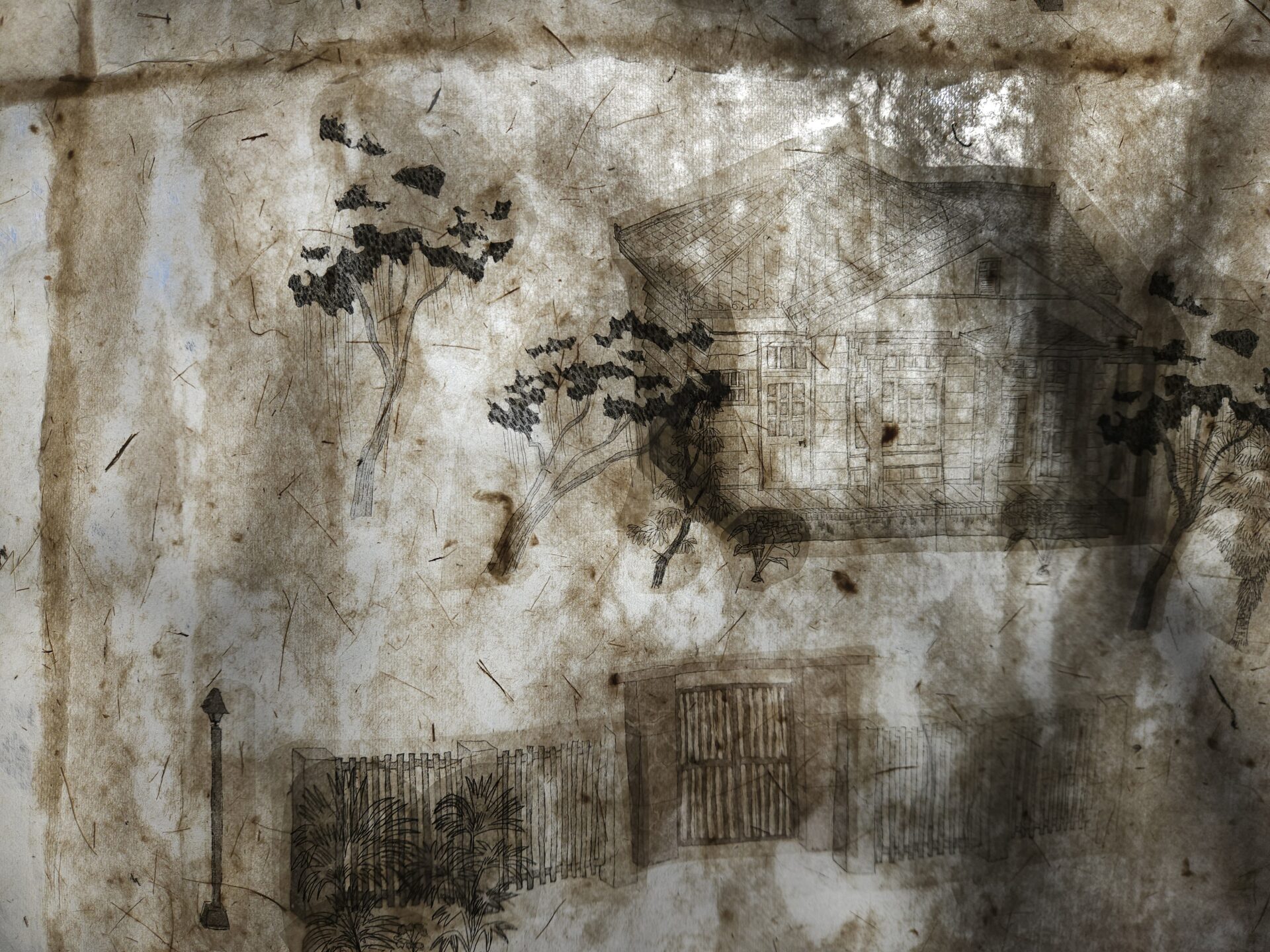
In Edward FuChen Juan’s detailed work, he focuses on the manipulation of materials, presenting it through his approach to papermaking. By tracing the Taiwanese traditions of Gampi papermaking, his choice to print his intaglio engravings on paper produced by the masters at Goang Xing Paper Mill inscribes his artistic reflections into the work.
As a member of the Taiwanese diaspora in Canada, Edward observes the challenges of truth and reconciliation in British Columbia, where he lives, alongside debates on transitional justice related to the beginning of the “White Terror” in 1947—a massacre of pro-democracy citizens that marked the onset of a violent dictatorial regime in Taiwan. This memory appears on the paper through the representation of Taiwanese architecture linked to dispossession, as well as through a repossession of his family narrative.
In Memory Crimes, the project finds its strength in the coexistence of collective and individual memories, as well as in the exploration of traditions. By developing expertise in papermaking, the artist incorporates plants endemic to Canada—notably beach grass and Douglas fir—layering and weaving the fibers of the territories he inhabits and that inhabit him, creating a paper house to foster new reflections on decolonization and healing.
Text by Éloïse Leblanc
Edward Fu-Chen Juan 阮福辰 is a visual artist based in Vancouver, BC, the unceded traditional territories of the xʷməθkʷəy̓əm (Musqueam), Sḵwx̱wú7mesh (Squamish), and Sel̓íl̓witulh (Tsleil-Waututh) Nations. He identifies as a queer Taiwanese Canadian with ethnic roots from the Hakka and the Plains First Nation People of Taiwan. His work focuses on the impact of human rights movement and decolonization within the Taiwanese diaspora in Canada and abroad. The work includes collecting oral histories coincide with visual documentation of people and places.
https://www.edjuan.com/